When did you last watch a good cricket match and said yourself, “What a match!”? Must seem ages, despite the flurry of T20 slogfests.
Thanks to the “Tallest man in world cricket”, as Gavaskar puts it, we all enjoyed a breathtaking innings, maybe of a lifetime.
The physical fitness and mental toughness of Sachin are admirable, if not adorable. What style, what composure, what character! What a man he is!
Critics might argue that he once again failed to take the team to the finishing line. But what are the other ten in the team doing? Perhaps they were mesmerized by the magical batting skills.
Whatever be the criticism, everybody ought to accept one thing. That Sachin is the best, perhaps the last of a dying breed called cricket genius. Until another genius is born, we’ll all have to be content with mediocrity, showmanship, and slogfests.
Monday, November 09, 2009


Saturday, September 19, 2009
Periyasamy Thooran
Recently, I read about one Periyasamy Thooran – a versatile scholar and a genius, whom The Hindu compared to Lewis Carroll. ‘Isaiperarignar’ Periyasamy Thooran’s birth centenary is being celebrated (?!) and quite naturally most of us are unaware of this great man. This great man did not sit for the final examination for his Bachelor’s degree in Mathematics at Presidency College – not because he wasn’t prepared, but to show his protest against the hanging of Bhagath singh.
Periyasamy Thooran is a multi-faceted personality. He has written short stories, poems, dramas, and essays. He is a Bharathi scholar, and most important of all, he has spent 20 precious years of his life to compile the first ever encyclopaedia in Tamil. He was the Chief Editor of the Tamil Encyclopaedia under the Presidentship of Sri. T.S. Avinashilingam Chettiar. The encyclopaedia came out as 10 volumes of 750 pages each. Then worked as the Chief Editor of Children's Encylopaedia in Tamil which was also published in 10 volumes of 100 pages each.
When the living ‘legends’ torture us with their birthday parties and large-scale celebrations, a true legend’s birth centenary is being ‘celebrated’ silently. After all, who wants his cut-outs installed all over the city roads. He never worked for fame.
The best thing we can do is to wipe the dust from those old volumes of encyclopedia and think for a while, about the pains a man has taken to compile knowledge in a beautiful language.
Periyasamy Thooran is a multi-faceted personality. He has written short stories, poems, dramas, and essays. He is a Bharathi scholar, and most important of all, he has spent 20 precious years of his life to compile the first ever encyclopaedia in Tamil.
 He was the Chief Editor of the Tamil Encyclopaedia under the Presidentship of Sri. T.S. Avinashilingam Chettiar. The encyclopaedia came out as 10 volumes of 750 pages each. Then worked as the Chief Editor of Children's Encylopaedia in Tamil which was also published in 10 volumes of 100 pages each.
When the living ‘legends’ torture us with their birthday parties and large-scale celebrations, a true legend’s birth centenary is being ‘celebrated’ silently. After all, who wants his cut-outs installed all over the city roads. He never worked for fame.
The best thing we can do is to wipe the dust from those old volumes of encyclopedia and think for a while, about the pains a man has taken to compile knowledge in a beautiful language.
Monday, August 31, 2009
Google Blooper
Pretty odd!
When you want to view something labeled "Your Stuff" but you're not allowed to view it! :-)
 From my Google Reader page
When you want to view something labeled "Your Stuff" but you're not allowed to view it! :-)
 From my Google Reader page
Monday, August 24, 2009
How to open multiple instances in Acrobat Reader
A little bit of technical stuff to share.
Suppose you're using Acrobat Reader 5.0 or 7.0, and you've already opened a pdf file. Now, you want to open another pdf file in a new window. Chances are that the second pdf file opens in the first window. Embarrassing, right?
Here is the solution:
Step 1: Open an Explorer window. Shorcut: Windows key + E (Or you can just open My Computer or My Documents). In this example, I've opened the My Computer window.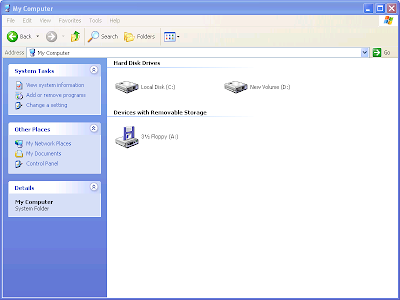
Step 2: Select Tools-Folder Options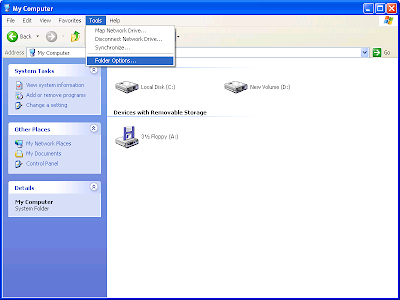
Step 3: Click the File Types menu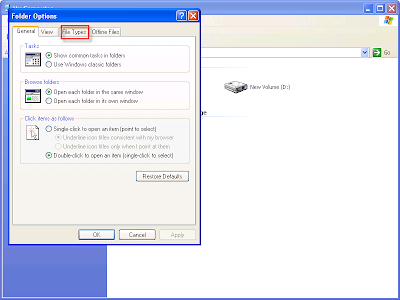
Step 4: In the Registered file types section, scroll down and select PDF and select Advanced button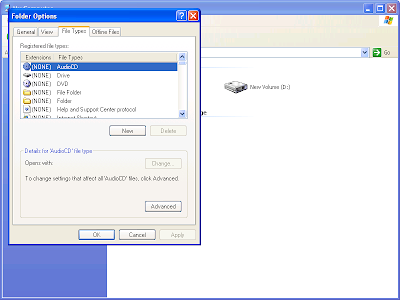
Step 5: Click Open and then click the Edit button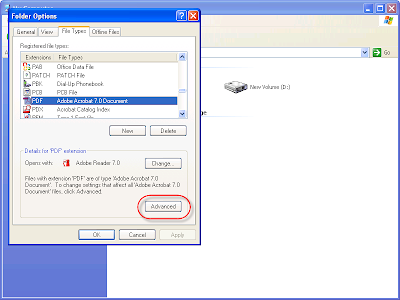
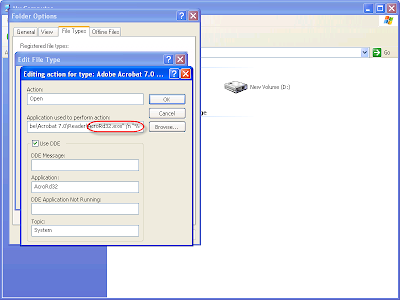
Step 6: Place the mouse cursor inside the Application used to perform action box, press the End key, and then add /n before the text "%"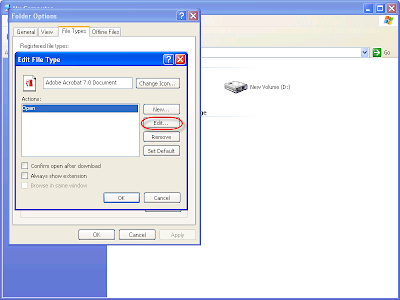
Step 7: Click OK, another OK, and finally Close.
Done.
You can now open multiple instances of pdf files. Keep rocking!
Suppose you're using Acrobat Reader 5.0 or 7.0, and you've already opened a pdf file. Now, you want to open another pdf file in a new window. Chances are that the second pdf file opens in the first window. Embarrassing, right?
Here is the solution:
Step 1: Open an Explorer window. Shorcut: Windows key + E (Or you can just open My Computer or My Documents). In this example, I've opened the My Computer window.

Step 2: Select Tools-Folder Options

Step 3: Click the File Types menu

Step 4: In the Registered file types section, scroll down and select PDF and select Advanced button

Step 5: Click Open and then click the Edit button

Step 6: Place the mouse cursor inside the Application used to perform action box, press the End key, and then add /n before the text "%"

Step 7: Click OK, another OK, and finally Close.

Done.
You can now open multiple instances of pdf files. Keep rocking!
Sunday, August 23, 2009
Vinayagamania
Ganesh chaturthi has become a high profile event over the past few years, thanks to the Shiv Sainiks et al, and the discount offers ranging from mobile phones to brand new cars.
Lord Ganesha is rather a down-to-earth sort of God. He doesn't ask for luxurious temples. Even an 'arasa maram' becomes sacred when Ganesha idol is incorporated underneath the tree.
Maybe we should entitle Vinaayaga "Lord of the People" for His humble residence, ready-as-you-go blessings, and charismatic personification.

People make all sorts of vinaayaga idols, keeping Him updated of the current affairs and their priorities. Kargil Vinaayagar is one classic example.
And the delicious dishes people make on this occasion is chanceless. The sundal with coconut scrapes, the white 'kozhukkattai' with a sweet semifluid inside, and an onion-shaped 'chuwingam' (not chewing gum) are the special declicacies of the day. As I go for my evening walk, the streets are clean - swept and washed, and unusually fragrant. Seerkazhi Govindarajan's high-decibel, inimitable voice echoes, 'Vinaayaganae, vinay theerpavanae...'
The sad part of the rituals is when they immerse the beautiful idols in water. But like Phoenix, Ganesha will emerge - not from ashes, but from clay - into different forms, but with the same spirit of religious symbolism and revival.
Friday, August 14, 2009
Living in a Conundrum
What leaders do after retiring is a case to study. When most of our leaders in India never retire (Even when they want to retire, they make their sons or daughters their political successors), leaders of other countries often surprise us by pioneering or participating in meaningful initiatives.
Charismatic
Bill Clinton is a charismatic leader who pioneers. Some charismatic ones like Vladimir Putin take up alternative leadership roles. And the likes of Tony Blair are often seen as a fading star, but still they’re stars.
Fidel Castro and Hugo Chavez enjoy much public respect and admiration of their people in spite of the negative projections foreign media make about them. Charisma has always been a major factor in the success of leaders.
Deserving Respect
Some leaders, though not charismatic, are still role models and make things happen. They are the DOERS, insisting persistence and perseverance. T.N.Seshan, who revolutionized the Indian electoral system, is one such leader. He was praised by the common man but often seen as a villain by politicians.
Kiran Bedi is a rare breed made of both charisma and administrative skills.
Brave and Beautiful, she made things happen, wherever the political iron hand tried to dump her. Transformation in the Tihar jail will tell what she achieved.
When we look at the East, Wen Jiabao and Hu Jintao demonstrate how to run a country without compromising on self-respect and integrity.
Looking back at India, I see the government run by the Prime Minister, who is run by the Congress leadership.
I see the Chief Minister making government portfolios his family possessions.
I see the ministers who don’t even attend 50% of the Parliament sessions and those who don’t even ask a single question there.
I see statue mania.
I see the petty politics leading to water wars between the states of my country.
I hear about voters being bribed, harrassed, or just ignored with their names not figuring in the rolls.
I read about the ‘donation’ collected by ministers through their colleges and schools.
I experience the lack of information and reluctance of public servants to provide information to the public.
I ask why the government bus driver drives so slowly, to get the answer that he, like every one else, has bribed a few lakhs of rupees to get the job. He can’t take any risk until he ‘earns’ at least the money he has put in.
I realize that I have to bribe two thousand rupees to get the thirty thousand rupees due to us after our grandfather’s death.
What has happened to this land of Gandhi?
I live entangled in a corrupt conundrum.
I wonder what makes this country go on?
It’s a miracle.
Tuesday, August 11, 2009
Gagne's Nine Events of Instruction
As a Content Writer, I sometimes need to update myself with the supposedly 'acquired' skills. One such skill is to remember the contribution of Robert M. Gagne, an educational psychologist and a pioneer in Instructional Designing. He devised his theory about the nine events that take place during an instruction. Popularly (at least within the e-Learning circles) known as Gagne's Nine Events of Instruction, this theory explains what goes into an effective instructional strategy.
I know this is one of the first lessons for experienced Instructional Designers. For others, I hope, this may be helpful.
Here is a short description of each of Gagne's nine events:
1. Gain Attention
Always start with auditory/visual stimuli, thought-provoking question, or an interesting fact. Curiosity motivates students to learn. These stimuli serve better than traditional modes because they enable the content to easily get registered in the learner's memory. And it's easy to retrieve than say a BIG paragraph.
2. Inform learners of objectives
I should know what I'm going to read before I start. And I should know what I will be able to do after learning the course. List the learning objectives at the start of every lesson. The objective must be self-explanatory, creating expectancy in the mind of the learner. All your assessment modules and certification must be based on these objectives.
A common syntax used is something like "Upon completing this lesson, you will be able to…".
3. Stimulate recall of prior learning
This is where all our favorite teachers score over the disliked ones. The good teachers give you real life examples so that you can relate the concepts to something practical. Take into account the learner’s personal experience and knowledge relating to the subject of discussion. This enables the learner to store information in long-term memory. Instead of merely explaining the sections of a money order form, you can create a lookalike form, introduce the purpose of the form, provide a scenario, and ask the learner to fill up the form. In an e-Learning environment, this is child's play.
4. Present the content
The course shouldn't look like an unedited movie, leaving it to the learner to make sense out of it. Chunk and organize content so that it makes sense. Add multimedia to enhance learning experience. Use audio, video, and graphics with text.

5. Provide learning guidance
In addition to the content, provide examples, case studies, graphical representations of data, mnemonics, and analogies. Make the presentation more appealing - visually and conceptually.
6. Elicit performance by practice
Make the learner practice the new skill or behavior learned now. Doing this verifies and confirms their correct understanding. And repetition is likely to increase retention. Practice until you perform should be the mantra.
7. Provide feedback
Practice without feedback doesn't make sense. Provide immediate feedback of the learner’s performance. You must provide specific feedback for every possible answer. Concentrate on comprehension and not on scoring during the tutorial. Provide ‘formative feedback’ in the form of additional information and explanations for each correct and incorrect answer.
8. Assess performance
A post test or a final assessment is as important as the instructional module itself. No assistance in the form of feedback or hint this time. Set a benchmark for the learner to achieve mastery. Normally, the level of mastery is achieved by scoring 80% to 90%.
9. Enhance retention and transfer to the job
Create instructional aids such as job aids, references, templates and wizards to aid the learner’s transfer to the job. Focus on performance through course design that enhances retention and hence performance.
You can see all these nine events happening right before your eyes and experience effective eLearning when you're reading a well-constructed e-Learning course. Good luck!
Tuesday, August 04, 2009
Clinton Did It!
It seems Presidents of United States do more after retiring than what they do when in power.
After Jimmy Carter, it's now Bill Clinton's turn to get involved in lot of social initiatives.
His recent endeavor resulted in freeing the two U.S. journalists arrested by North Korea.
It is a rare case of unorthodox diplomacy from the part of the United States. Clinton has now served as the global ambassador for the U.S., projecting himself beyond boundaries.
The Clinton foundation is involved in a wide variety of development projects that cover diverse fields from struggle against AIDS to global climate initiative.
Clinton may be on his way to the pinnacle of public appreciation and recognition of his service. He may get the Nobel Prize too.
After Jimmy Carter, it's now Bill Clinton's turn to get involved in lot of social initiatives.

His recent endeavor resulted in freeing the two U.S. journalists arrested by North Korea.
It is a rare case of unorthodox diplomacy from the part of the United States. Clinton has now served as the global ambassador for the U.S., projecting himself beyond boundaries.
The Clinton foundation is involved in a wide variety of development projects that cover diverse fields from struggle against AIDS to global climate initiative.
Clinton may be on his way to the pinnacle of public appreciation and recognition of his service. He may get the Nobel Prize too.
Sunday, August 02, 2009
A Pinch of Salt
A famous Tamil proverb says, "Uppillaa Pandam Kuppayilae", meaning anything that doesn't contain salt is to be dumped in the trash. A pinch of salt makes all the difference between a delicious meal and an insipid one.
And a handful of salt, when it was in Mahatma Gandhi's hand, showed the world what a real revolution is. It seems after Dandi, we've almost forgotten the humble salt. We often find ourselves unable to answer questions like how they produce salt, or what methods are used to extract salt.

How would it feel like when you explore all by yourself a salt pan, interacting with the 'salt people', observing, inferring, and photographing places and events, and above all, applying your knowledge. That's what Nomita, my friend and ex-colleague has done.
A jovial, talkative, and 'Yea, I've read that in a wonderful book...' kind of girl with appreciable knowledge in Biology and Earth Science, Nomita makes an impression within the first 5 minutes (if at all you can stand that :D) you talk to her. She talks Harry Potter, reads Paulo Coehlo, discusses Marine Biology, and explains gold hallmarking process, all with the same interest and enthusiasm. Here's an update of her recent visit, accompanied by her brother, to a salt pan as a part of her project:
http://picasaweb.google.co.in/lh/sredir?uname=nomita.b&target=ALBUM&id=5364632848100209809&locked=true&authkey=Gv1sRgCPL255PsqpOrUQ&feat=email
I thank Nomita for sharing the link with us, and making this article worth its salt.
And I came across this old issue of Frontline, covering the life of Agariya tribes in the Little Rann in Gujarat.
Wednesday, July 29, 2009
Swiss Army Knife
The celebrated Swiss Army Knife turns 125.
This knife was designed to help Swiss soldiers to dismantle their gun and to open food tins.
The next version came in the form of "Originally named "Schweizer Offizier Messer", eventually becoming a universal cult icon.
An interesting article is available on the BBC site here.
And the Guinness World Record making knife with 314 blades, making it the world's biggest penknife, was also created - putting pride ahead of everything else.
I wish I had one in my pocket.
Tuesday, July 28, 2009
Martial Arts Syndrome
In the name of martial arts, people break bricks, and even get themselves run over by vehicles. I wonder what is martial about it. Or what art is there in it?
A recent news article has drawn our attention towards such acts of 'bravery' supported in a government school near Villupuram, Tamilnadu.
Children were made to lie down with their hands stretched on the ground. A man rode his motorcycle over the hands. This act was witnessed and appreciated by the crowd of parents, teachers, and onlookers.

What are they going to achieve by these 'feats'?
Can they ever escape when run over by an MTC bus or a speeding truck?
Why don't they just teach self-defence?
There are lot of other strategies to develop endurance.
What is there to be proud of such things?
I simply don't understand.
A recent news article has drawn our attention towards such acts of 'bravery' supported in a government school near Villupuram, Tamilnadu.
Children were made to lie down with their hands stretched on the ground. A man rode his motorcycle over the hands. This act was witnessed and appreciated by the crowd of parents, teachers, and onlookers.

Image courtesy: Times of India
What are they going to achieve by these 'feats'?
Can they ever escape when run over by an MTC bus or a speeding truck?
Why don't they just teach self-defence?
There are lot of other strategies to develop endurance.
What is there to be proud of such things?
I simply don't understand.
Wednesday, July 22, 2009
Learning Esperanto
In a comment to my previous post, Brian Barker has suggested the site:
http://en.lernu.net
Exploring this site, I found that learning Esperanto is cool. And the course designed by Hokan Lundberg and Bertilo Wennergren is straight-forward and user-friendly (without any false links and unwanted bells and whistles).
I started by learning Esperanto numerals. It's pretty easy to learn and remember.
Basic numbers
0 - nul
1 - unu
2 - du
3 - tri
4 - kvar
5 - kvin
6 - ses
7 - sep
8 - ok
9 - naŭ
10 - dek
100 - cent
1000 - mil
11 - dek unu
12 - dek du
20 - dudek
25 - dudek kvin
237 - ducent tridek sep
1983 - mil naŭcent okdek tri
2002 - du mil du
And I took up a 'Level 1' exercise and scored centum!
Interested? Try http://en.lernu.net/lernado/gramatiko/konciza/kalkulvortoj.php
Good luck!
Tuesday, July 21, 2009
Esperanto
For aspirants of a unified world, Esperanto might be one of the answers.
Esperanto was devised in the 1880s by Dr. Ludwig Lazar Zamenhof (1859-1917) who was a Jew, born in Poland. Disheartened by the strong anti-Semitic feelings of the time, Zamenhof formulated Esperanto as a neutral international second language. He thought this would pave way for the liberation of Jews from the hands of racism.
Commenting on the formation of a separate Jewish state out of erstwhile Palestine, he said,
In his book Dr Esperanto, Zamenhof defines a simple grammar and a vocabulary of 900 words. He derived these words from Romanesque, Germanic and Slavic languages.
To create new words, you an add appropriate suffixes and prefixes.
Optimists say Esperanto will become the new international language sometime in the future. We'll have to wait and see.
And Esperanto means 'Hopeful'.
Esperanto was devised in the 1880s by Dr. Ludwig Lazar Zamenhof (1859-1917) who was a Jew, born in Poland. Disheartened by the strong anti-Semitic feelings of the time, Zamenhof formulated Esperanto as a neutral international second language. He thought this would pave way for the liberation of Jews from the hands of racism.
Commenting on the formation of a separate Jewish state out of erstwhile Palestine, he said,
"Jews will be living there as if on a volcano… conflicts and persecutions there will not stop until the Jews are expelled from there once again".
In his book Dr Esperanto, Zamenhof defines a simple grammar and a vocabulary of 900 words. He derived these words from Romanesque, Germanic and Slavic languages.
To create new words, you an add appropriate suffixes and prefixes.
Optimists say Esperanto will become the new international language sometime in the future. We'll have to wait and see.
And Esperanto means 'Hopeful'.
Sunday, July 19, 2009
Newsbringers
We take so many things for granted. Newspaper is one of them.
The newspaper reaches us after passing hundreds of hands, miles of transportation, and finally the sweats of the paperboy. What does it take to be a paperboy? Definitely, you need several skills to be one. You got to balance yourself and the huge stock of papers on the carrier and both sides of the handle bar of your bicycle. You got to move swift as a sparrow through narrow streets. You got to protect the papers from the rain, dirt, and other things. And finally, you got to DELIVER - at the right time, at the right place.
I came across an interesting book titled "Rain: What a Paperboy Learned About Business" by Jeffrey J. Fox. Though the book is written in an American context, the concepts discussed holds in any environment. The author lists some great people of the U.S.A., who were paperboys in their early years. The list includes Isaac Asimov, physicist, Warren Buffett, investor, Tom Cruise, actor, Thomas Alva Edison, inventor, Martin Luther King Jr., civil rights activist, Jeff Taylor, founder of Monster.com, and many others. Immediately, I thought of our own Dr. A.P.J. Abdul Kalam, who used to deliver papers in his hometown.
Jeffrey Fox observes that most of those who've worked as paperboys are successful in several fields. He even suggests that hiring former paperboys is smart business. He explains the importance of sincerity, dedication, hard work, and all other qualities essential for a paperboy, which are as essential to any business. He uses a simple case study of an enthusiastic teenager named Rain, and applies his experience to common business strategies. It's a very simple book with a great attitude. Worth keeping in offices to boost employee commitment.
The newspaper reaches us after passing hundreds of hands, miles of transportation, and finally the sweats of the paperboy. What does it take to be a paperboy? Definitely, you need several skills to be one. You got to balance yourself and the huge stock of papers on the carrier and both sides of the handle bar of your bicycle.
 You got to move swift as a sparrow through narrow streets. You got to protect the papers from the rain, dirt, and other things. And finally, you got to DELIVER - at the right time, at the right place.
I came across an interesting book titled "Rain: What a Paperboy Learned About Business" by Jeffrey J. Fox. Though the book is written in an American context, the concepts discussed holds in any environment. The author lists some great people of the U.S.A., who were paperboys in their early years. The list includes Isaac Asimov, physicist, Warren Buffett, investor, Tom Cruise, actor, Thomas Alva Edison, inventor, Martin Luther King Jr., civil rights activist, Jeff Taylor, founder of Monster.com, and many others. Immediately, I thought of our own Dr. A.P.J. Abdul Kalam, who used to deliver papers in his hometown.
Jeffrey Fox observes that most of those who've worked as paperboys are successful in several fields. He even suggests that hiring former paperboys is smart business. He explains the importance of sincerity, dedication, hard work, and all other qualities essential for a paperboy, which are as essential to any business. He uses a simple case study of an enthusiastic teenager named Rain, and applies his experience to common business strategies. It's a very simple book with a great attitude. Worth keeping in offices to boost employee commitment.
Wednesday, July 01, 2009
Thank You, Professor Yash Pal!
“My daughter has come first in the whole district in the tenth standard board exams,” my English teacher boasted in our class. I retorted to my friend Gopi “No wonder. After all he didn’t teach her.” Parents want their children to be Number One either because they were Number One in their times or they weren’t Number One in their times. Newspapers show the Number One celebrating his or her (mostly her) success with their parents or friends.
In the background, schools dump the mostly irrelevant and unpractical concepts into the young minds, eating the time which the children should have been playing or having some kind of fun. As a CBSE student, I used to boast “our syllabus is tougher than state board syllabus. Getting 350 out of 500 there is like getting 450 here.”
With students easily crossing the 400 mark and now the 450 mark, more stress has been put on presentation of answers, optimal choice of questions, and other intricacies. Eventually, I gave up my ambition of becoming a teacher. Practically, I’d have been a facilitator, bullying students all day‘Each mark is important. Each second counts. The Board Exam is your life. Don’t repent later.’ Being a teacher, I’d have ended up teaching nothing, which I’m doing right now.
Talking about education sector reform is fun. But implementation isn’t. When the nation builders are ready to implement the sixth pay commission recommendations with immediate effect, they cite bureaucratic bottlenecks in implementing reforms, or even mild changes. And the reform committees and enquiry commissions in this country work in their own way. Hence they take their own time. Take the Liberhan Commission for instance. Set up in December 1992, the retired judge took 16 years, 48 extensions, and 399 sittings to submit his report. And what the hell is it going to tell? The whole nation witnessed what happened, who laughed, who cried, who never laughed, who did everything, and who did nothing.
The review committee on the National Curriculum Framework, headed by Prof. Yash Pal, has been comparatively efficient and faster. It took only 3 years to submit the report.
Professor Yash Pal, the great Indian Scientist who brought Science to the common man’s drawing room through Turning Point in Doordarshan, has come up with his remarkable and revolutionary recommendations. The main recommendation is the making the Standard X public exam optional.
Another recommendation is the formation of a centralized and more autonomous body on the lines of the Election Commission to replace the time-tested and failed bodies such as UGC, AICTE, and NCTE.
Talented and deserving people are being put into nation building – for example Nandan Nilekani in the Unique ID project. Good sings. Thanks, Professor Yash. At least kids will have the relief that they don’t have to be the ‘State Number One’ and ‘District Number One’ until Standard XII now.
Tuesday, June 23, 2009
Memories From the Travel Bag
What made them select Tada falls – almost an unknown place – at least to some non-travelers like me – for a one-day trip? Two simple reasons are:
1. Tada
2. Falls
Yes, Tada was a literally unknown (and legally controversial) name which most of us hadn't heard of. And the second reason is that nobody hates falls – I mean waterfalls.
Skillsoft is a fun-loving team, doing things with a Synergy of work and play. With a well-planned schedule, we were all set to start the hilarious journey at 5.30 a.m. on 13th of June, a lovely Saturday morning. No delays in deliverables this time!
One must acknowledge the role the behind-the-scenes guys played. Syed and Sethu booked the 'small mini bus' (more about this later); Prakasham and Santhosh almost made a Guinness record for peeling the most number of garlic in a short time; Dominic and Prasanna made the chicken cross the road.
Saif Ali Khan had come to Mike's home to inaugurate the journey. Saif posed for a couple of snaps with us and bid us Bon Voyage.

Dull but anxious moments followed, as we were watching out for guys about to join us on the way. Things got lively once Wilson got into the bus. Six-pack Sasi was the last one to join us from Puzhal. He got the typical Koduva team (the team that gives you special treatment on your birthday) welcome, headed by Pandian. For the information of non-Tamils, Koduva roughly means a kind of dagger.
We stopped for breakfast at an open field. Mike, our project manager, was busy distributing idlies rather like Ejaman Rajinikanth. All eyes were on Santhosh because he had the sambar bowl. After idly, we were chatting idly. That was when Mike came up with another surprise.
We celebrated Wilson's birthday in that open field. Once again, a typical Koduva team treatment.

The journey continued. Disappointment was awaiting us when we found that our 'small mini bus' will not be allowed to enter Tada. The reason was that the bus was a 12+1 carrier with 18 seats. Our ‘We know the IG' strategy didn't work. Resources were deployed for Localization. In spite of speaking the best Telugu we knew, the only choice the check post officials gave us was to remove the additional seats. A viable alternative was to use local transport. What an innovative way to make the local industry flourish!
As they say, everything happens for good. The best part of our journey was in the four Share Autos we hired. Here too, we proved our mettle in bargaining. We went for the lowest bidder principle and brought down the rate from Rs.500 to Rs.350. We enjoyed the peppy songs the driver played for us. The highway soon became narrow and then transformed into a mud road. What seemed to be a road less travelled gave us a roadless travel. At times, we had to get down and push the auto. It was fun all the way.
We may run, walk, stumble, drive, or fly, but let us never lost sight of the reason for the journey, or miss a chance to see a rainbow on the way.
This spirit made us click our cameras every now and then. And there were more falls in the water than there was water in the falls. Deepika, the whistling DJ started it all when she skidded and fell into the dangerous water knee-high. Then it was Ranjani’s turn on our way back. Soon, JS was at her heels as if it was a chain of events. And nobody knew why Rama forgot her high heels, eventually landing on a sharp piece of a broken wine bottle. Well, we had the first aid kit. Now she has a good reason to apply for a leave.
Carrying 20 litre water cans while going to a waterfall may sound odd. But we did it. The team worked rather like a military squad, ferrying heavy utensils across streams and efficiently passing logistics – baggage, wood, water cans, and vessels.
After crossing a couple of streams, we reached the Sivan temple beside which a group of local people lived. Fifteen more minutes of negotiating another stream led us to a perfect place to cook and bathe. For some reason, we didn't occupy that place. We moved forward, to find another curious place. Most of us were very hungry, ready to pounce at anything that was edible. It's time to start music.
Mike rediscovered fire with the help of the kerosene we had taken in a big bottle.

A resourceful kitchen was established in minutes. Syed proved that he is a professional when it comes to cooking. The aroma of his Biriyani didn't only make our hungry stomachs crave but it also attracted a troop of monkeys! Seems they too are non-vegetarian. It was news to me.

When Syed & Co were toiling in the makeshift cookery, a group of bad boys sneaked downhill to revel in water. Eating the mangoes from the nearby trees while bathing was a different experience. We then had a satiating feast thanks to Syed, Santhosh, and Prabhu.

And thanks to the girls group, who, tears in their eyes, peeled onion and cut vegetables in no time. Were they worried that they had to eat the food cooked by guys?
Once we ran out of water, we started drinking the river water after boiling it. Mike was at his best when he led from the front, cleaning the vessels. As it grew darker and the forest bugs got louder, we packed up and it was once again fun in the Share Autos – this time a bit more adventurous as it was dark.
It was time to leave hot and spicy Andhra. Our small mini bus was waiting at the check post to take us back to Chennai. One by one, the guys bid farewell, satisfied with the evergreen journey. We’ll be back to the concrete jungles, trekking our way to office through traffic jams. With nostalgic resolution, we said to Tada falls “WE’LL BE BACK.”

Here is a nice travelogue if you're planning a trip to Tada falls
Thursday, April 17, 2008
Who named Black Holes and Warmholes?
You might have wondered - or just taken for granted - who coined the terms black hole and warmhole?

And the man who named these mysterious places (or absence of space) is no more. John Archibald Wheeler is his name. He has spent his time with greats like Niels Bohr, Albert Einstein, and DeWitt. And his students include Richard Feynman, Jacob Bekenstein, and Huge Everett. Most of know about Feynman (for his lectures). Bekenstein proposed that a black hole's event horizon is a measure of entropy. Stephen Hawking is said to have discovered the fact that black holes radiate, led by Bekenstein's thinking. And Huge Everett proposed the idea of 'many worlds' interpretation in Quantum Mechanics. (Wikipedia says he left physics as he found that other physicists didn't accept his theories. However, he managed to become a millionaire, being a defense analyst and consultant.)
Back to Wheeler's story, he was the pioneer who sought to combine gravity and quantum mechanics, leading to the development of the field called Quantum Gravity. He was awarded the Wolf Prize in Physics in the year 1996-97.
And it's one more obituary in this column. We've lost another great mind.
Monday, March 24, 2008
Sir Arthur Clarke - The Futurologist
Being a futurologist is like ropewalking.
It's highly likely that people mistake you for astrologer or a supernatural power holder with an adept skill for predicting.
Yet, futurology is based on Science and facts, and the extraordinary power of extrapolation.
Excerpts from Raymond Whitaker's article in The Independent, Sunday, 23 March 2008
See what Sir Arthur Clarke had predicted. These five things have become taken-for-granted facts today:
1. Geo-Synchronous satellites - The ones that always seems over our heads like the sword of Damascus!
Clarke was the first to suggest that satellites which remain at a fixed point relative to Earth could be used for worldwide communications. The geostationary orbit is now known as the "Clarke orbit".
2. The Internet - Wherever you go, you follow the network!
The father of the internet, Sir Tim Berners-Lee credits Clarke's short story, Dial F for Frankenstein, as an inspiration.
3. Spaceguard - The Asteroid Tracking System
In his novel Rendezvous With Rama, Clarke created "Project Spaceguard", a system to track asteroids that might collide with Earth. When such a system was set up in 1996, it was called "Spaceguard", in homage.
4. The Space Station - 'I told you so....'
The space station, now under construction, was put on screen in 1968 by Clarke and Stanley Kubrick in 2001: A Space Odyssey.
5. N-Powered Spacecrafts - Reactors on board
In 1951 Clarke envisaged nuclear-powered spacecraft, a prediction that came true with several satellites, launched by the Soviet Union, which had small reactors on board.
Cool! What's coming next?
Well... Here's the list:
1. Space Ladder
In his 1979 novel, In The Fountains of Paradise Sir Arthur Clark suggested a "space lift", a geostationary satellite tethered to the Earth's surface, that allows men and materials to travel up and down without having to blast into orbit. Advancements in Carbon nanotube technology may make the 22,000-mile-long tether feasible.
2. Prince Harry will be going into Space in 2013. That's more than possible.
3. Virtual Reality will be more real. By 2025 the brain's functions will be fully mapped, allowing us to experience full sensory immersion.
4. There will be two intelligent species on Earth - one biological, and the other non-biological. The so-called artificial intelligence will at least catch up with the natural intelligence.
5. The Universal Replicator. By 2040, a "universal replicator" will be made and it will be capable of cloning anything from caviar to diamonds.
It's highly likely that people mistake you for astrologer or a supernatural power holder with an adept skill for predicting.
Yet, futurology is based on Science and facts, and the extraordinary power of extrapolation.

Excerpts from Raymond Whitaker's article in The Independent, Sunday, 23 March 2008
See what Sir Arthur Clarke had predicted. These five things have become taken-for-granted facts today:
1. Geo-Synchronous satellites - The ones that always seems over our heads like the sword of Damascus!
Clarke was the first to suggest that satellites which remain at a fixed point relative to Earth could be used for worldwide communications. The geostationary orbit is now known as the "Clarke orbit".
2. The Internet - Wherever you go, you follow the network!
The father of the internet, Sir Tim Berners-Lee credits Clarke's short story, Dial F for Frankenstein, as an inspiration.
3. Spaceguard - The Asteroid Tracking System
In his novel Rendezvous With Rama, Clarke created "Project Spaceguard", a system to track asteroids that might collide with Earth. When such a system was set up in 1996, it was called "Spaceguard", in homage.
4. The Space Station - 'I told you so....'
The space station, now under construction, was put on screen in 1968 by Clarke and Stanley Kubrick in 2001: A Space Odyssey.
5. N-Powered Spacecrafts - Reactors on board
In 1951 Clarke envisaged nuclear-powered spacecraft, a prediction that came true with several satellites, launched by the Soviet Union, which had small reactors on board.
Cool! What's coming next?
Well... Here's the list:
1. Space Ladder
In his 1979 novel, In The Fountains of Paradise Sir Arthur Clark suggested a "space lift", a geostationary satellite tethered to the Earth's surface, that allows men and materials to travel up and down without having to blast into orbit. Advancements in Carbon nanotube technology may make the 22,000-mile-long tether feasible.
2. Prince Harry will be going into Space in 2013. That's more than possible.
3. Virtual Reality will be more real. By 2025 the brain's functions will be fully mapped, allowing us to experience full sensory immersion.
4. There will be two intelligent species on Earth - one biological, and the other non-biological. The so-called artificial intelligence will at least catch up with the natural intelligence.
5. The Universal Replicator. By 2040, a "universal replicator" will be made and it will be capable of cloning anything from caviar to diamonds.
A Tribute to Sri Arthur C Clarke

'Sri' in the title is not a typo, but has some relevance here:
1. He was living in Sri Lanka since 1956.
2. 'Sri' is roughly equivalent to 'Sir', because it denotes respect and reverence.
What do Jules Verne and Sir Arthur Clarke have in common?
Well.. it may be their profound interest and knowledge in the field they were writing.
In his own words: "To me, science and science fiction writing are two sides of the same coin. Science fiction writing can only be valuable to us if it is written by someone who has some knowledge of science."
Maybe there has to be a thin line between good Science Fiction and Fantasy.
Alas! We're often unable to distinguish, thanks to the generations that spoiled the genre.
Writing was just one of the passions of Sri Arthur Clarke. He is regarded the Father of Satellite Communication. He has contributed to the development of RADAR technology. And he was of the stern belief that one day we'll be intelligent enough to communicate with Aliens.
And Sir Arthur Clarke didn't believe in the supernatural or the paranormal.
But that's only an option. Does it matter?
Friday, March 07, 2008
Ten Toughest Jobs To Do in Chennai
You may be doing the toughest job in the world - sorting your e-mails, keeping track of facebook posts, and wondering whether you'll get the ticket for Jodha Akbar tonight. Never mind. Here are what I think the ten most toughest jobs to do in Chennai.
1. Scavenger
I've seen these men dip into the manhole in which we fall only in accidents, scoop all the litter in the underworld, dump them in a tray, continuing this process again and again, until the maistry is convinced. They do this wearing only the underwear. And they still manage to smile when they come out, cutting a sorry figure. These men are extremely healthy - for their immune system is boosted. And the last time a crow shitted on my favorite shirt, I was cursing all the crows under the sun. What about these people?
2. Garbage collectors
These people too are a strange species. They either work for the municipal corporation, or they are self-employed(!) garbage gatherers. The municipal workers can be seen merrily sitting on heaps of garbage they filled the truck with. Nowadays there's even a small spot on each side at the rear of the garbage truck. Long live the municipality. The ragpickers have a sharp tool to pick reusable plastic materials. Hope most of them realize the rags-to-riches dream.
3. Construction Worker
Day and night, rainy or sunny, flashing brightness or intimidating darkness, the work must go on. Yes, with the real estate industry on an unprecedented high that preceds an inevitable low, these people are always on call. Demolish old ones, build new ones. Build, build, build. I wonder what must be in the mind of a worker on a thirteenth floor construction spot, trusting only the makeshift scaffold. And if you're a woman, and your tasks involve carrying bricks and cement to places, wear your saree tight and right. It's such a safe world.
4. Traffic Controller
Why are these people in THIS list? Because they suffer a lot. Forget their salary. Forget their designation. They breathe the black city air; they tolerate the honkers' brays; and they have the risk of being run over by a speeding vehicle at any time. As we know, they have their heart in mouth when a VVIP passes by.
5. Bus Driver
Two wheelers overtake you on both sides. Mindless passengers get in and get out in signals and where there are no bus stops. It's a bumper to bumper traffic almost all the time. And yes, this is the life of a bus driver. And they have the repution of being rude. Some maybe right. And some wrong.
6. Cook in a local restaurant
You don't know today's temperature. But you know how hot it is. And there is no proper smoke exit. Perhaps you use the same cloth - to shift hot utensils, to wipe spilled curry, and to wipe your nose in case you have cold. Who cares? Welcome to the world of a cook in a local restaurant. I thought of giving the 6th spot to film operators in theaters, but let's be serious.
7. Ambulance Driver
I've seen an ambulance stuck up in a traffic jam for more than 10 minutes. And nobody gave way - nobody could. As if everyone is about to die soon. Think of the ambulance driver's pulse. Does he feel guilty of no mistake of his?
8. Courier Boy
You're not Jim Courier. They always suspect you. People always blame you for unclear address. You stroll around each nook and corner of the city - to find a worthless guy receiving worthless letter. Anyway, you have a job at hand. Keep it up!
9. Attender
This includes Office Attenders, and attenders of all sorts - for attenders nowadays have attenders too. You do all tasks not of yours. You pay someone else's electricity bills (of course they give you the money), you get lunch for some couch potato pretending to work with minimized Facebook window, you are the subject of rotten old jokes they manage to make. And yet you attend to everything.
10. Vegetable Vendor
I might sound a bit communist, or socialist. But with retail market invaded by giant chains, the vegetable vendor is left to the mercy of the lower middle class.
You have to pedal or push your vegetable 'store', park it so that you don't interrupt traffic, and sometimes need to talk business with Number 4 in this list, or some other man who is said to be running the law and order of the city.
I think this list is not to change for quite some time. Designations may vary, but not the problems. Are you one among the ten? If not, stop worrying. Mind your business.
1. Scavenger
I've seen these men dip into the manhole in which we fall only in accidents, scoop all the litter in the underworld, dump them in a tray, continuing this process again and again, until the maistry is convinced.
 They do this wearing only the underwear. And they still manage to smile when they come out, cutting a sorry figure. These men are extremely healthy - for their immune system is boosted. And the last time a crow shitted on my favorite shirt, I was cursing all the crows under the sun. What about these people?
2. Garbage collectors
These people too are a strange species. They either work for the municipal corporation, or they are self-employed(!) garbage gatherers.
 The municipal workers can be seen merrily sitting on heaps of garbage they filled the truck with. Nowadays there's even a small spot on each side at the rear of the garbage truck. Long live the municipality. The ragpickers have a sharp tool to pick reusable plastic materials. Hope most of them realize the rags-to-riches dream.
3. Construction Worker
Day and night, rainy or sunny, flashing brightness or intimidating darkness, the work must go on. Yes, with the real estate industry on an unprecedented high that preceds an inevitable low, these people are always on call. Demolish old ones, build new ones. Build, build, build. I wonder what must be in the mind of a worker on a thirteenth floor construction spot, trusting only the makeshift scaffold. And if you're a woman, and your tasks involve carrying bricks and cement to places, wear your saree tight and right. It's such a safe world.
4. Traffic Controller
Why are these people in THIS list?
 Because they suffer a lot. Forget their salary. Forget their designation. They breathe the black city air; they tolerate the honkers' brays; and they have the risk of being run over by a speeding vehicle at any time. As we know, they have their heart in mouth when a VVIP passes by.
5. Bus Driver
Two wheelers overtake you on both sides. Mindless passengers get in and get out in signals and where there are no bus stops. It's a bumper to bumper traffic almost all the time. And yes, this is the life of a bus driver. And they have the repution of being rude. Some maybe right. And some wrong.
6. Cook in a local restaurant
You don't know today's temperature. But you know how hot it is. And there is no proper smoke exit. Perhaps you use the same cloth - to shift hot utensils, to wipe spilled curry, and to wipe your nose in case you have cold. Who cares? Welcome to the world of a cook in a local restaurant. I thought of giving the 6th spot to film operators in theaters, but let's be serious.
7. Ambulance Driver
I've seen an ambulance stuck up in a traffic jam for more than 10 minutes. And nobody gave way - nobody could. As if everyone is about to die soon. Think of the ambulance driver's pulse. Does he feel guilty of no mistake of his?
8. Courier Boy
You're not Jim Courier. They always suspect you. People always blame you for unclear address. You stroll around each nook and corner of the city - to find a worthless guy receiving worthless letter. Anyway, you have a job at hand. Keep it up!
9. Attender
This includes Office Attenders, and attenders of all sorts - for attenders nowadays have attenders too. You do all tasks not of yours. You pay someone else's electricity bills (of course they give you the money), you get lunch for some couch potato pretending to work with minimized Facebook window, you are the subject of rotten old jokes they manage to make. And yet you attend to everything.
10. Vegetable Vendor
I might sound a bit communist, or socialist. But with retail market invaded by giant chains, the vegetable vendor is left to the mercy of the lower middle class.

You have to pedal or push your vegetable 'store', park it so that you don't interrupt traffic, and sometimes need to talk business with Number 4 in this list, or some other man who is said to be running the law and order of the city.
I think this list is not to change for quite some time. Designations may vary, but not the problems. Are you one among the ten? If not, stop worrying. Mind your business.
Subscribe to:
Posts (Atom)
